AI Fortune Telling and Astrology Apps: Market Size, Growth and Leaders
How big is the AI astrology and fortune telling market? Market size and growth charts, the leading apps compared, and MOIRA, a Chinese-language newcomer.
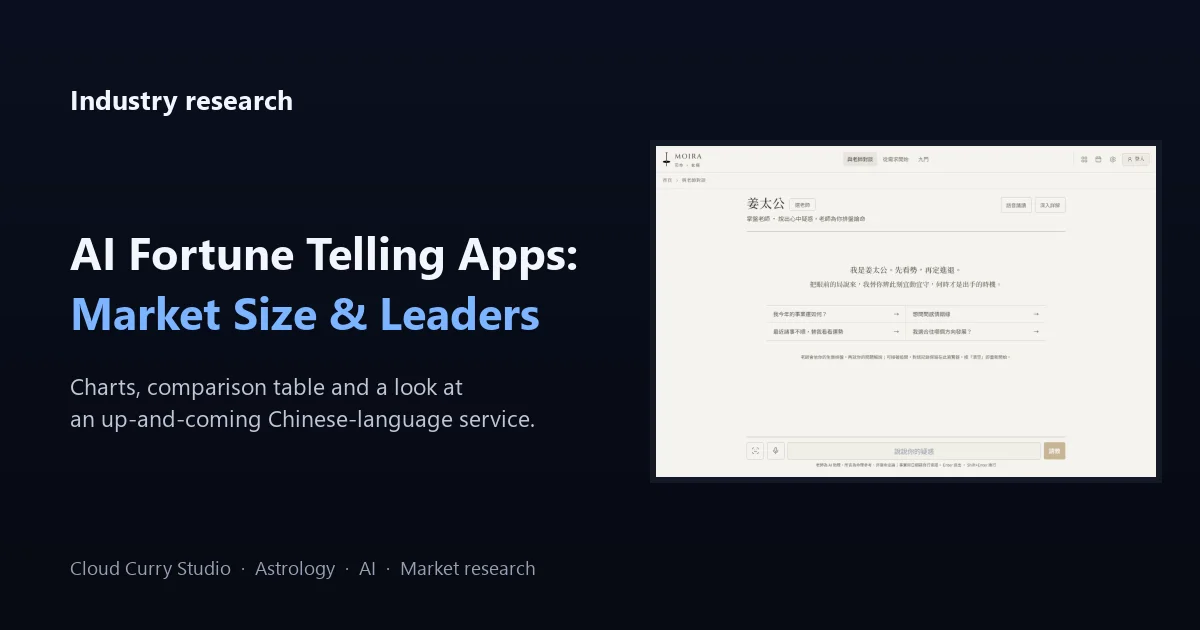
Astrology used to be a newspaper column. Today it is an app category with its own subscription economy, and AI chat has made it more personal than ever. This research post looks at how big the AI fortune telling and astrology market is, how fast it is growing, who leads it, and where a newer, Chinese-language service called MOIRA fits in. It is off-topic for this blog, which is normally about our own apps, and we say so up front: MOIRA is a friend's project, not ours.
Quick answer
- Market size: about $5 to $16 billion in 2026 for astrology apps, depending on the analyst.
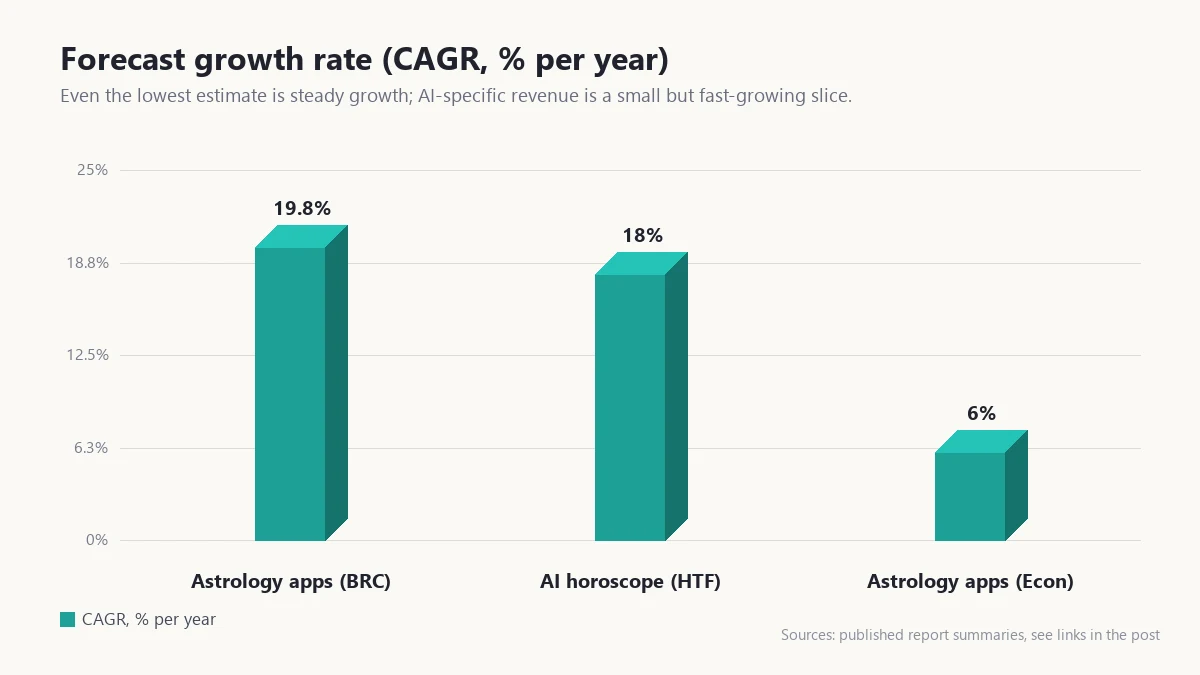
- Growth: from 6% to nearly 20% a year in published forecasts.
- AI-only segment: a small slice, forecast at about $120 million (2024) growing to $350 million (2032).
- Leaders: Co-Star, Nebula and The Pattern, all subscription-led.
- Newcomer to watch for Chinese readers: MOIRA, with nine traditions and pay-per-question AI chat.
Market size: what the analysts say
Published figures disagree, and some come from vendor blogs, so here are the clearest ones side by side.
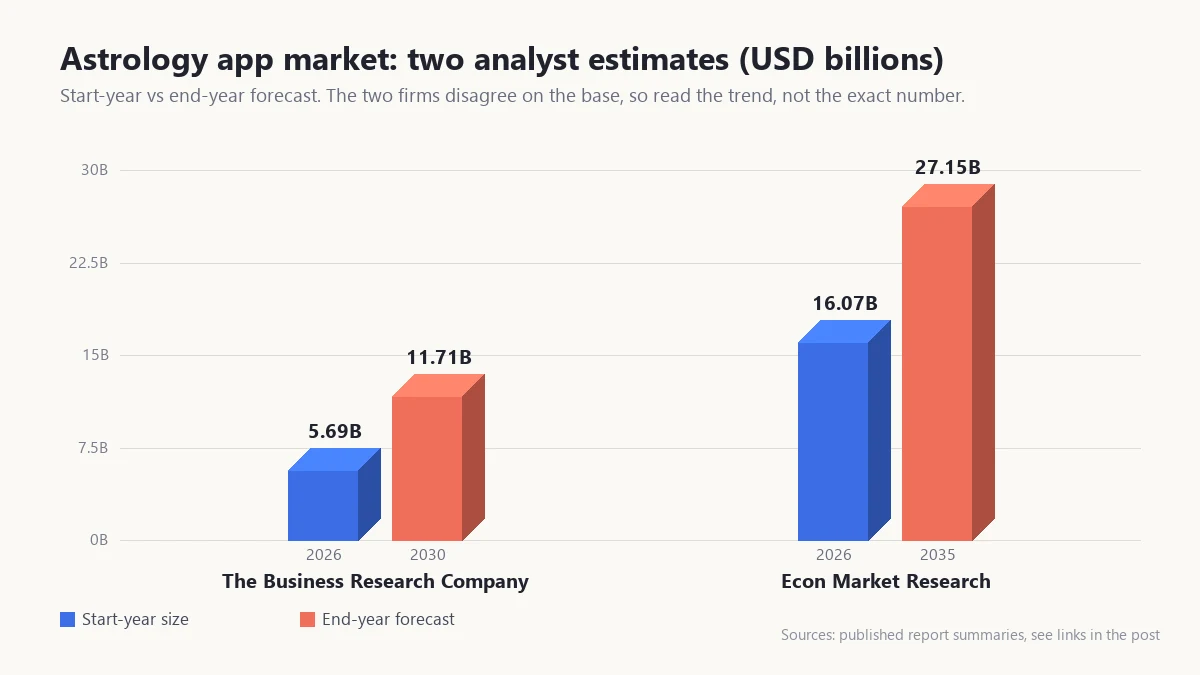
| Source | 2026 size | Forecast | Growth rate |
|---|---|---|---|
| The Business Research Company | $5.69B | $11.71B by 2030 | 19.8% a year |
| Econ Market Research | $16.07B | $27.15B by 2035 | 6% a year |
| HTF Market Insights (AI only) | about $0.12B in 2024 | about $0.35B by 2032 | 18% a year |
One comparison site notes that 2026 estimates range anywhere from $1.26B to $8.28B, and that roundups of astrology app statistics are inconsistent. A fair reading: a multi-billion-dollar category, growing at a double-digit pace in most forecasts, with the AI-specific share still small and poorly measured.
Why AI changes the category
- Personalisation. A chart is the same for everyone born at the same time. A chat lets you ask your own question, such as career timing or relationship worries.
- Lower cost per reading. A live human reading can cost several dollars a minute. A chat answer costs a fraction of that.
- Traditions that were hard to access. Systems such as Zi Wei Dou Shu or BaZi need long calculations and years of training to read. Software handles the calculation and AI explains it.
- Trust questions. The main concern is hallucination: a model that invents chart details. The better services calculate the chart with deterministic software and let the model only explain it.
The leaders
| App | Reported scale | How it makes money | Style |
|---|---|---|---|
| Co-Star | 20 to 30 million users reported (sources conflict) | Free core, paid Plus and personalised questions | Social, chart comparison with friends |
| Nebula | About 4 to 12 million downloads reported; sources conflict | Weekly subscription (about $7.99 reported), live readings billed per minute | Wide range: horoscopes, live astrologers |
| The Pattern | About 8 million monthly users and 10 million downloads reported | Free core, paid Pattern Plus | Personality and relationship insight |
These figures come from third-party blogs and app-store estimate sites, not from the companies, and they disagree with each other. A Surfshark study also looked at how much data astrology apps collect, which is worth reading before you hand over your birth details. For current prices, always check each app's store page.
A newcomer for Chinese-language readers: MOIRA
Most of the apps above are English-first and centred on Western astrology. Readers who want Zi Wei Dou Shu (紫微斗數), BaZi (八字), feng shui or the almanac in Traditional Chinese have fewer choices. MOIRA (司命 · 玄樞) is built for exactly that audience. It is a friend's project, and here is what we saw when we tried it.
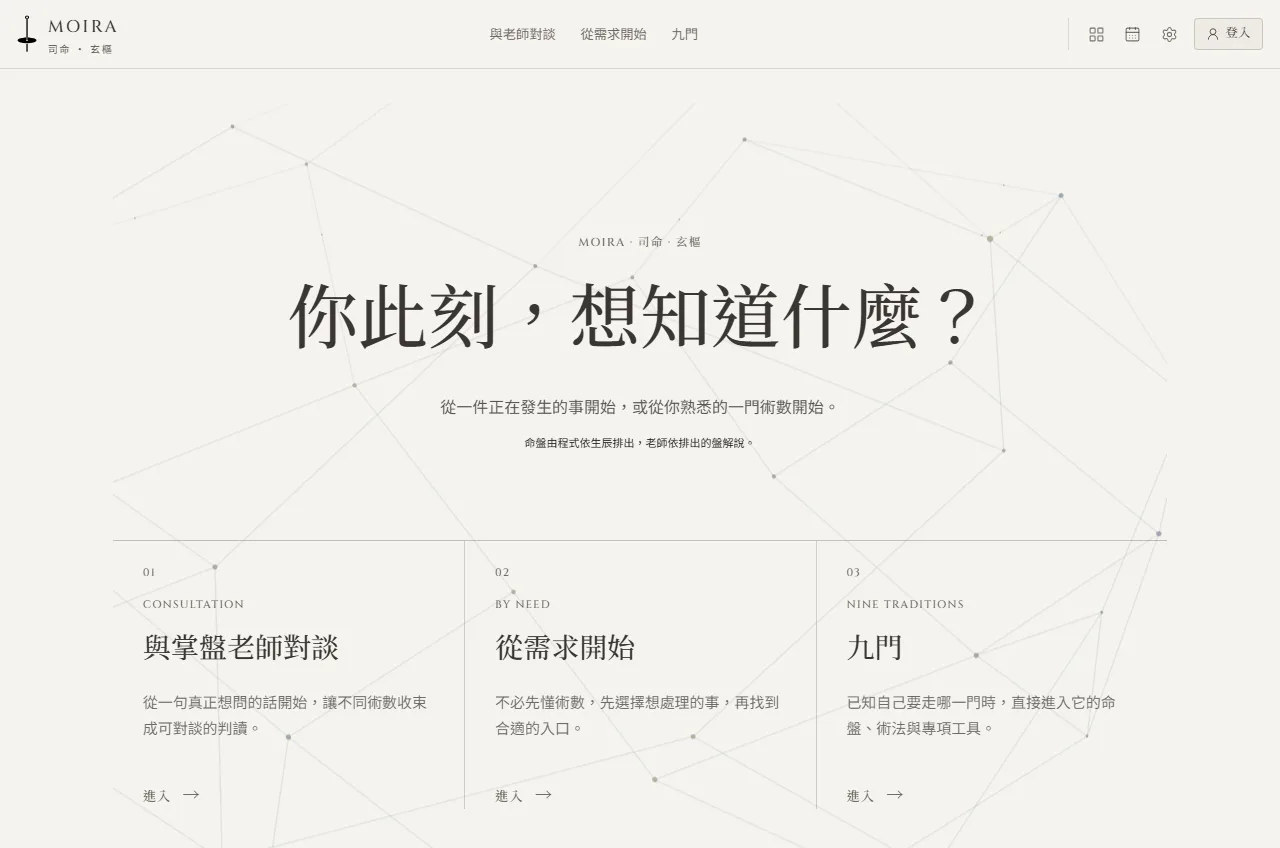
Three ways in: chat with a "chart-reading teacher", start from a need (career, relationships, choosing a date, feng shui, names), or pick one of nine traditions.
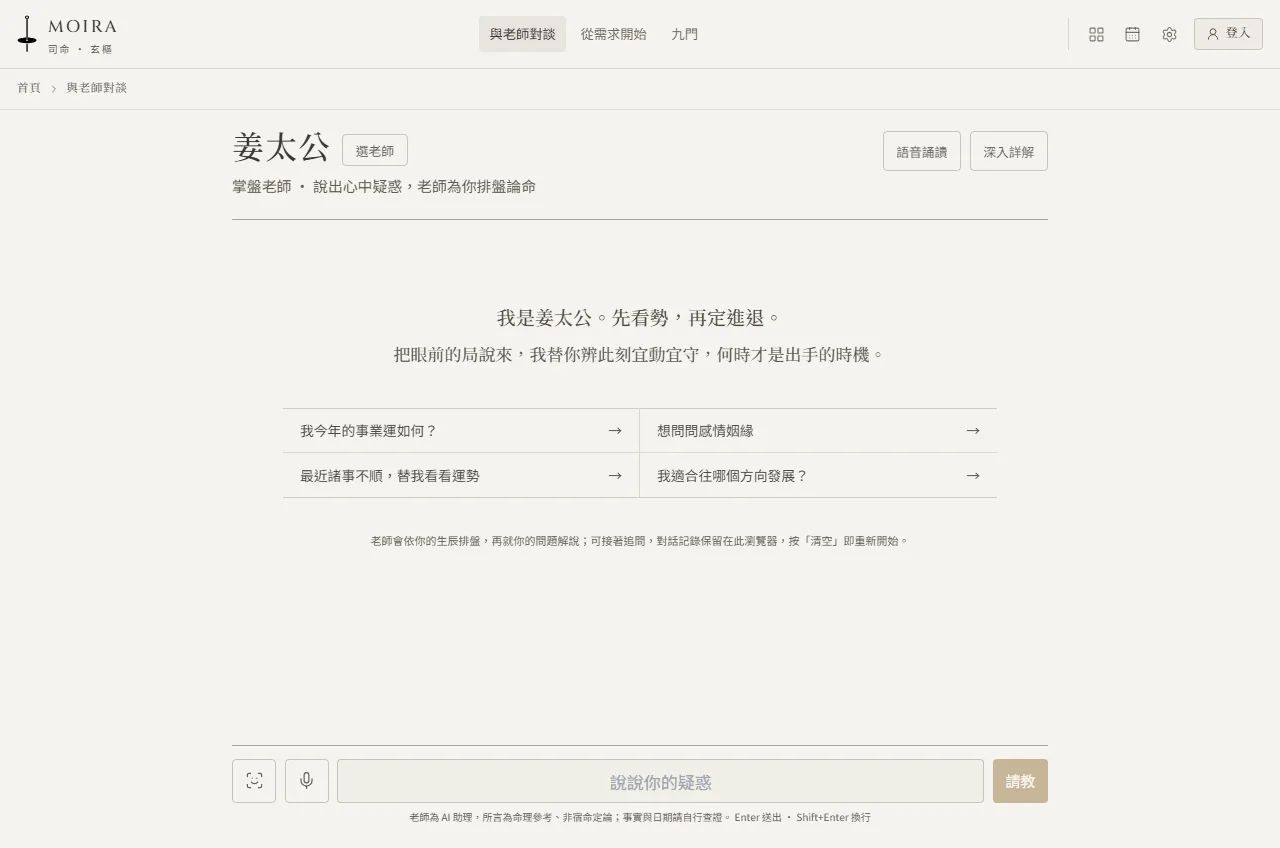
The chat page tells you plainly that the teacher is an AI assistant and that answers are reference, not destiny, with facts and dates left for you to verify. The teacher builds a chart from your birth details, picks a method that fits the question, then explains it, and you can ask follow-ups. Chat history stays in your browser.
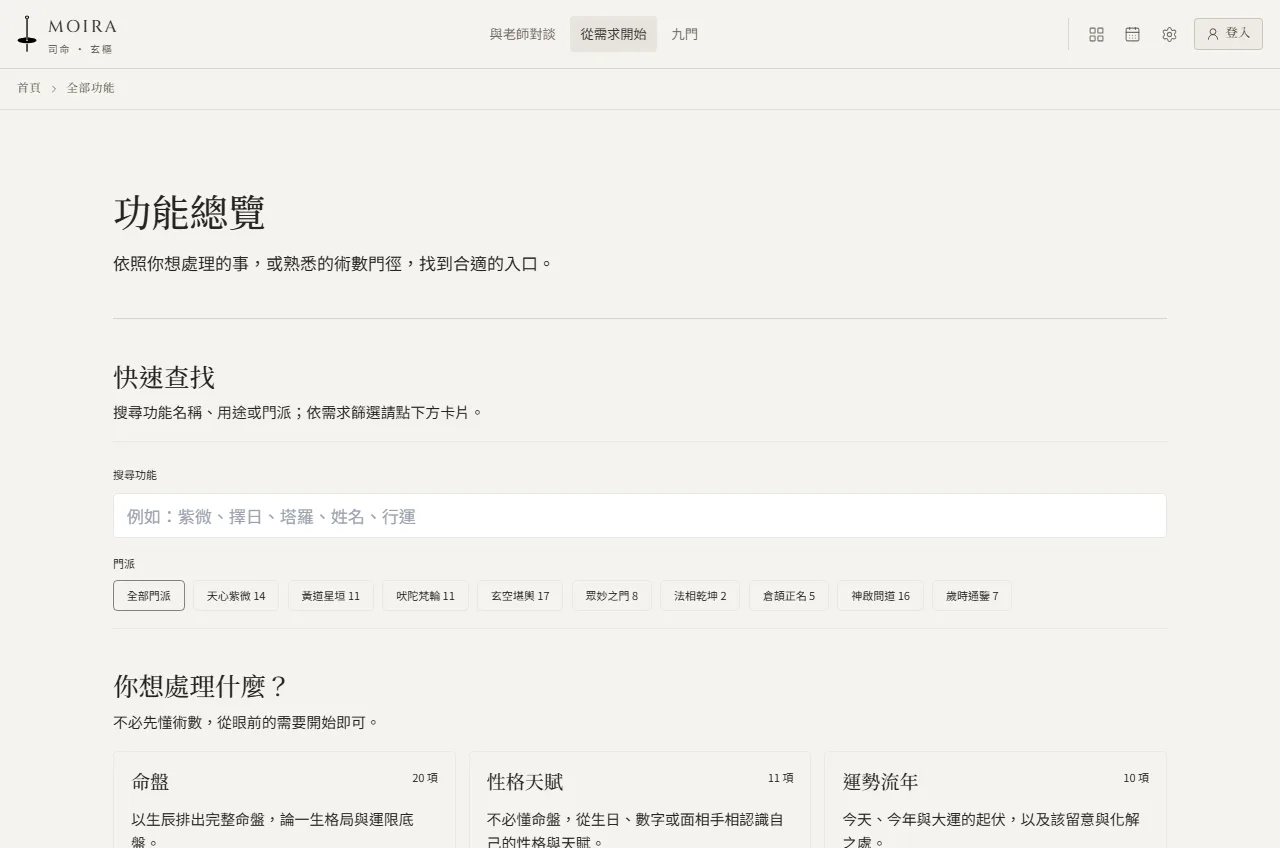
Breadth is the strongest point. The nine traditions are Zi Wei Dou Shu with BaZi and Qi Zheng, Western astrology, Vedic astrology, Xuan Kong feng shui, an integrated approach, face and palm reading, name analysis, divination, and the almanac. The feature overview lists dozens of tools across these, from natal charts and compatibility to choosing auspicious dates, and a search box filters them.
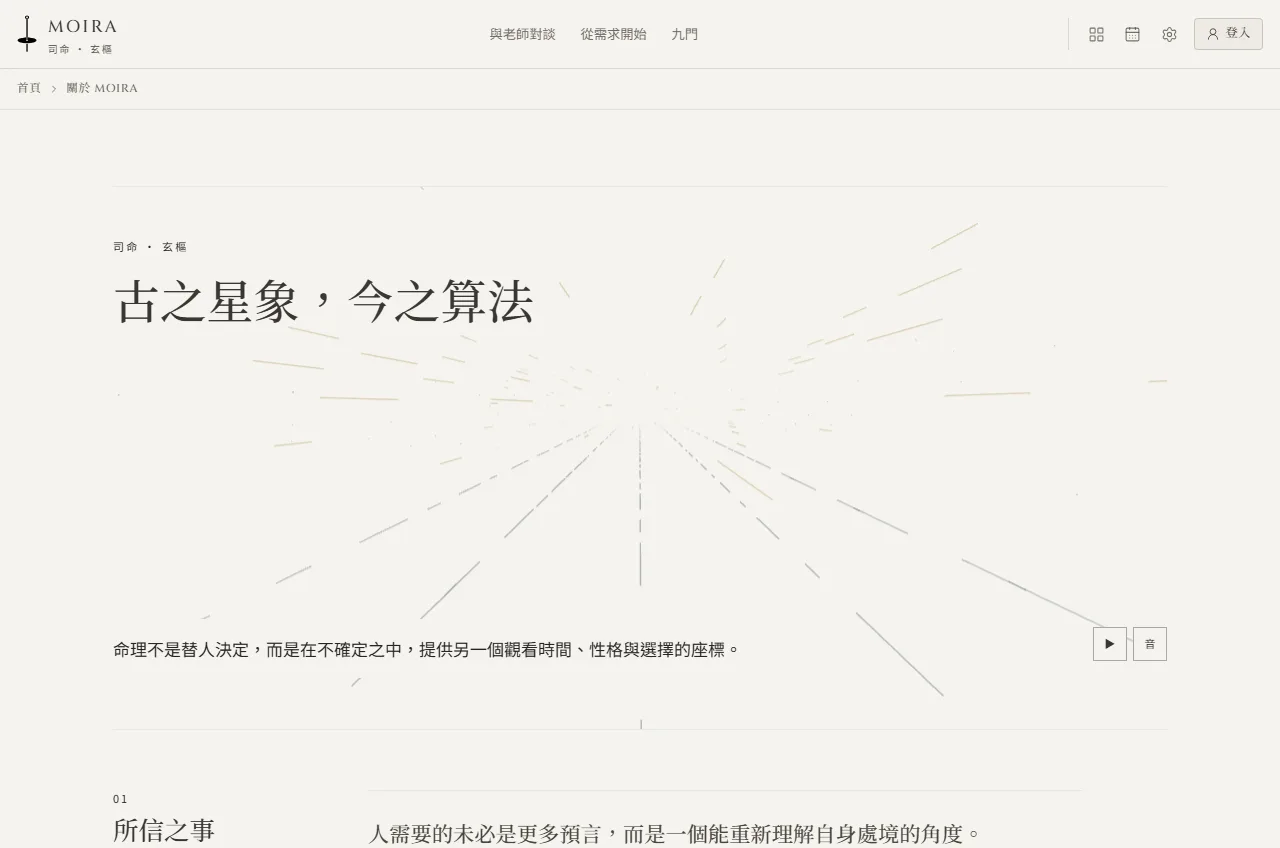
How it handles AI. The about page states that the chart is produced first by a deterministic algorithm and the language model only organises context and explanation, so it cannot quietly alter the chart. It also says that where schools of thought disagree, it shows the disagreement instead of a single answer. The home page adds that the site uses only local browser storage for preferences, with no tracking cookies and no ad platforms.
Pricing. The chart tools are free. Logged-in members get one free AI chat a day. After that, AI chat is NT$5 per question from prepaid points (for example NT$100 for 20 chats), with no subscription and no auto-renewal. Unused points can be refunded, used ones cannot.
How MOIRA compares
| Co-Star | Nebula | The Pattern | MOIRA | |
|---|---|---|---|---|
| Main language | English-first | English-first | English-first | Traditional Chinese |
| Traditions | Western | Several styles, check the app | Western, personality focus | Nine, including Zi Wei, BaZi, Vedic, feng shui |
| AI chat | Paid questions | Yes, plus live readings | Paid questions | Yes, 1 free per day |
| Pricing model | Free core, paid Plus | Subscription plus per-minute | Free core, Plus | Pay per question, no subscription |
| Public user numbers | Reported | Reported | Reported | None published |
| Explains how AI is used | Not stated here | Not stated here | Not stated here | Yes, on its about page |
A fair summary: MOIRA is not one of the market leaders by users, since it is new and publishes no usage numbers. It stands out for depth of Chinese traditions, a pay-as-you-go price and clear disclosure of how AI is used. We could not test how accurate its readings are, and no one can verify an astrology reading. Treat any service, including this one, as reflection and entertainment.
How to choose an AI astrology service
- Language and tradition. Pick a service that actually covers the system you care about.
- Pricing you understand. Prefer clear terms. Subscription apps often draw complaints about cancellation and billing clarity.
- Disclosure. Look for a plain statement that the reading is AI generated and not a prediction.
- Privacy. You are giving your birth date, time and place. Read what is stored and whether there is a delete option. MOIRA links a data deletion page.
- Do not rely on it for big decisions. Medical, legal and investment choices need professionals.
The bottom line
The astrology app market is large, growing, and still dominated by Western-style subscription apps, while AI is a small but fast-growing slice. For Chinese-language users there is room for services built around Zi Wei Dou Shu, BaZi and feng shui, and MOIRA is a promising newcomer in that space: try the chat, browse the features, or read how it works.
Disclosure: MOIRA is run by a friend of the site owner. Market figures are summarised from the linked third-party reports and may have changed.
Frequently asked questions
How big is the astrology app market?
Published estimates for 2026 range from about $5.7 billion (The Business Research Company) to about $16 billion (Econ Market Research). Some sources are lower or higher, so treat any single figure as an approximation.
How fast is the AI astrology market growing?
One report (HTF Market Insights) projects the AI horoscope and astrology market growing from about $120 million in 2024 to about $350 million by 2032, an 18% compound annual growth rate. The wider astrology app market is forecast at 6% to nearly 20% a year depending on the firm.
What are the biggest AI astrology apps?
Co-Star, Nebula and The Pattern are the names that appear most often. Reported user counts differ widely between sources, for example 20 to 30 million users for Co-Star, so check the app store listings for current figures.
Are AI fortune telling readings accurate?
Astrology and fortune telling are for reflection and entertainment, not prediction. No independent accuracy testing of AI readings turned up. A good service says so, and cross-checking the chart against a separate calculator is sensible.
What is the difference between a chart calculation and an AI reading?
The chart is produced by deterministic software from your birth data. An AI model then explains it. MOIRA states that the chart is calculated first by a deterministic algorithm and that the language model only explains the result.
Is there an AI fortune telling service for Traditional Chinese speakers?
Yes. MOIRA is a Traditional Chinese service covering Zi Wei Dou Shu, BaZi, Western and Vedic astrology, feng shui, face reading, name analysis, divination and an almanac, with a free tier and pay-per-question AI chat.
How much does AI astrology chat cost?
Subscription apps are often priced weekly or monthly, with live readings billed per minute. MOIRA charges NT$5 per AI chat from prepaid points, with one free chat per day for logged-in members.
Try MOIRA yourself
A Traditional Chinese astrology and fortune telling service with free chart tools and AI chat. Not run by Cloud Curry Studio.